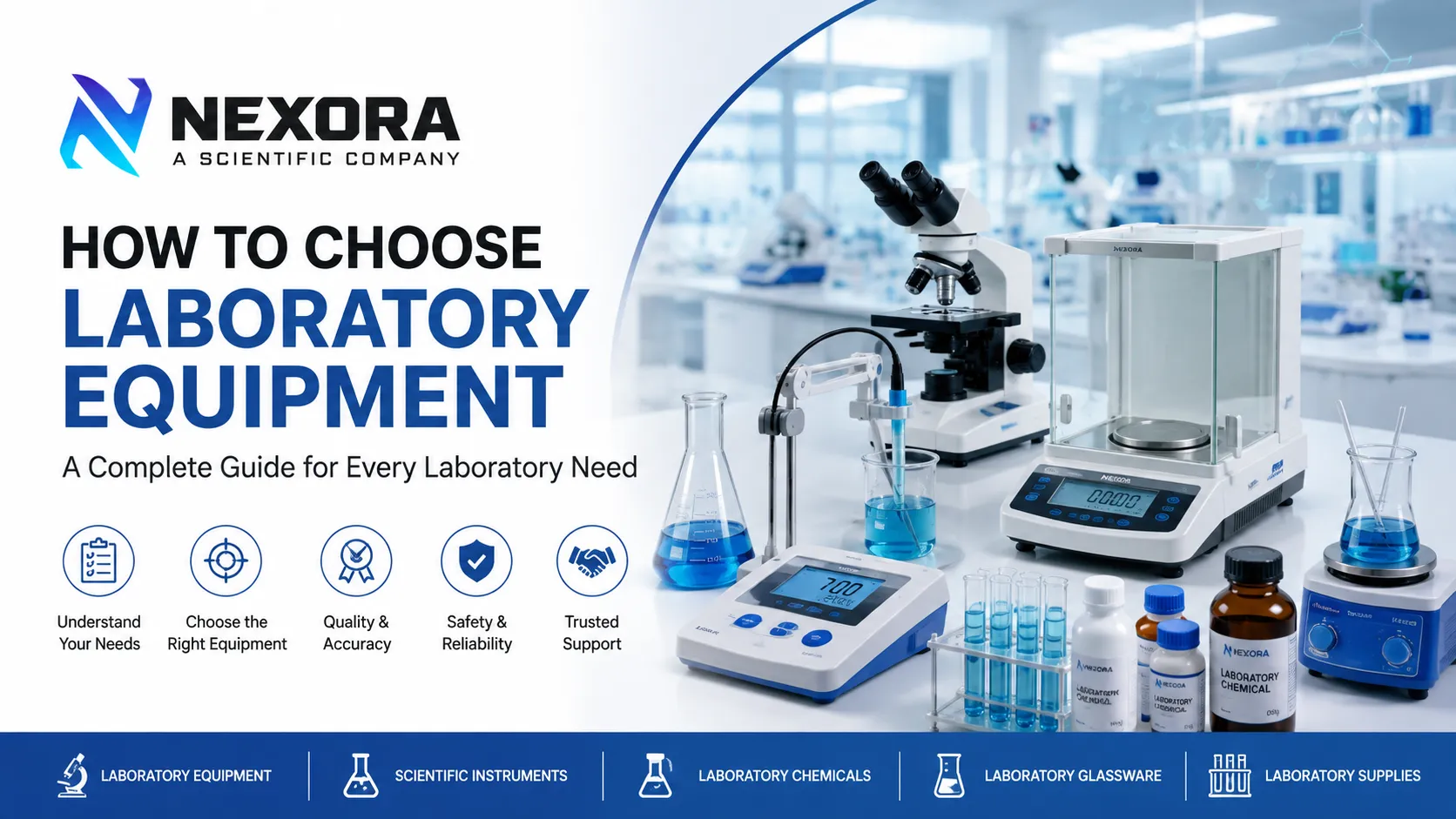
Choosing the right laboratory equipment is essential for accurate testing, reliable results, efficient research, and laboratory safety. Whether you are setting up a new laboratory, upgrading existing facilities, or purchasing equipment for a specific application, selecting the right products requires careful consideration.
Laboratories may need a combination of laboratory equipment, scientific instruments, analytical instruments, laboratory chemicals, glassware, and laboratory supplies depending on their work.
In this guide, we explain the key factors to consider when choosing laboratory products for research, testing, chemical analysis, pharmaceutical applications, quality control, water testing, microbiology, education, and industrial laboratories.
1. Understand Your Laboratory Requirements
The first step is to identify exactly what you need the equipment for.
Different laboratories have different requirements. A chemical laboratory may require analytical instruments, chemical compounds, glassware, heating equipment, and weighing instruments, while a water testing laboratory may require pH meters, conductivity meters, turbidity meters, and other water analysis equipment.
Before purchasing, consider:
- What type of testing will be performed?
- What samples will be tested?
- How frequently will the equipment be used?
- What accuracy is required?
- What capacity do you need?
- Will the equipment be used for research, testing, or quality control?
- What laboratory space is available?
Clearly defining your application makes it easier to select suitable laboratory products.
2. Choose Equipment Based on Application
Laboratory equipment should always be selected according to its intended application.
For example:
Chemical Analysis
Chemical laboratories may require:
- Analytical balances
- Hot air ovens
- Magnetic stirrers
- Heating equipment
- Spectrophotometers
- Laboratory glassware
- Chemical reagents
Water Testing
Water quality laboratories may require:
- Digital pH meters
- Conductivity meters
- Turbidity meters
- Water testing instruments
- Laboratory glassware
- Sample preparation equipment
Microbiology
Microbiology laboratories may require:
- Laboratory incubators
- Autoclaves
- Centrifuges
- Laboratory glassware
- Sample preparation equipment
- Sterilization equipment
Pharmaceutical Testing
Pharmaceutical laboratories may require:
- Analytical balances
- UV-Visible spectrophotometers
- Laboratory ovens
- Incubators
- Centrifuges
- Glassware
- Analytical instruments
Selecting equipment based on the actual application helps avoid unnecessary purchases and ensures that the laboratory has the right tools for its work.
3. Consider Accuracy and Measurement Requirements
Accuracy is one of the most important factors when purchasing laboratory instruments.
For measurement-based equipment, check specifications such as:
- Accuracy
- Resolution
- Measurement range
- Repeatability
- Capacity
- Sensitivity
- Operating conditions
For example, when selecting an analytical balance, consider the required weighing capacity and readability. When selecting a pH meter, consider the measurement range, resolution, and intended application.
Always compare technical specifications with your laboratory’s actual requirements rather than choosing equipment based only on appearance or price.
4. Select the Right Laboratory Glassware
Laboratory glassware is essential for many laboratory applications, including sample preparation, mixing, measuring, heating, and storage.
Common laboratory glassware includes:
- Beakers
- Conical flasks
- Volumetric flasks
- Measuring cylinders
- Test tubes
- Reagent bottles
- Pipettes
- Burettes
- Funnels
When selecting glassware, consider the required volume, application, material, temperature conditions, chemical compatibility, and measurement requirements.
For many laboratory applications, appropriate glass quality and correct product specifications are important for safe and reliable laboratory work.
5. Choose Laboratory Chemicals Carefully
Laboratory chemicals and reagents should be selected according to the required grade, purity, application, packaging, and safety requirements.
Depending on the application, laboratories may use different grades of chemicals for:
- Chemical analysis
- Research
- Quality control
- Sample preparation
- Educational laboratory work
- Industrial testing
Before purchasing a chemical, check its product specifications, safety information, concentration, grade, packaging, and intended application.
Proper storage and handling are also essential for laboratory chemicals.
6. Check Quality and Product Specifications
Quality should be an important consideration when selecting laboratory products.
Before purchasing, review:
- Product specifications
- Technical parameters
- Material and construction
- Operating range
- Capacity
- Application suitability
- Documentation
- Warranty or service information where applicable
A laboratory product should meet the technical requirements of the application rather than simply being selected because it is inexpensive.
7. Consider Laboratory Space and Installation
Laboratory equipment comes in different sizes and configurations.
Before purchasing larger equipment, check:
- Available floor or bench space
- Electrical requirements
- Ventilation requirements
- Temperature conditions
- Water or drainage requirements where applicable
- Access for installation
- Maintenance access
This is particularly important for equipment such as ovens, incubators, autoclaves, furnaces, centrifuges, and other laboratory systems.
Planning the installation area before purchasing can prevent unnecessary problems later.
8. Consider Maintenance and Support
Laboratory equipment is an investment, so maintenance and technical support should also be considered.
Ask about:
- Installation requirements
- Maintenance
- Spare parts
- Calibration requirements
- Technical support
- Warranty
- Service availability
For frequently used laboratory instruments, reliable support can help maintain consistent performance and reduce unnecessary downtime.
9. Compare Products Before Purchasing
Avoid selecting laboratory equipment based only on the lowest price.
Instead, compare products based on:
Application + Specifications + Quality + Reliability + Support + Total Cost
A suitable laboratory product should provide the required performance while fitting your budget and laboratory requirements.
For organizations purchasing multiple products, it can also be useful to request a quotation from a laboratory equipment supplier and compare specifications before making a final decision.
10. Buy From a Reliable Laboratory Supplier
Choosing a reliable supplier can make laboratory procurement easier.
A good laboratory equipment supplier should be able to provide clear product information and assist customers with selecting suitable products.
Depending on your requirements, you may need a supplier who can provide:
- Laboratory equipment
- Scientific instruments
- Analytical instruments
- Laboratory chemicals
- Laboratory glassware
- Laboratory supplies
- Testing equipment
- Research products
Having multiple laboratory product categories available from one supplier can simplify purchasing and communication.
Laboratory Equipment Buying Checklist
Before placing an order, use this simple checklist:
| Requirement | Check |
|---|---|
| Application identified | ✓ |
| Required specifications confirmed | ✓ |
| Capacity selected | ✓ |
| Accuracy requirements checked | ✓ |
| Product quality reviewed | ✓ |
| Laboratory space confirmed | ✓ |
| Safety requirements considered | ✓ |
| Maintenance requirements reviewed | ✓ |
| Supplier information checked | ✓ |
| Quotation compared | ✓ |
Why Choosing the Right Laboratory Products Matters
The right laboratory products can help laboratories improve testing efficiency, measurement reliability, research workflows, quality control, and day-to-day laboratory operations.
Whether you need a single scientific instrument or multiple products for a complete laboratory setup, understanding your requirements before purchasing can help you make a more informed decision.
Nexora Lab Solutions — Laboratory Products for Scientific Applications
Nexora Lab Solutions supplies a range of laboratory equipment, scientific instruments, laboratory chemicals, laboratory glassware, analytical instruments, and laboratory supplies for different scientific and testing applications.
Our products are suitable for research laboratories, pharmaceutical laboratories, chemical laboratories, food testing laboratories, water testing laboratories, microbiology laboratories, educational institutions, healthcare facilities, and industrial laboratories.
If you are looking for laboratory products, share your requirements with our team for product selection, availability, and quotation assistance.
Need Laboratory Equipment or Scientific Products?
Contact Nexora Lab Solutions for product information and purchase assistance.
📞 89627-70334 / 93011-40589
✉️ nexoralaboratory1210@gmail.com
🌐 www.nexoralabsolutions.com